Picture this: It's 11 PM. You promised yourself you'd stop scrolling and go to bed by 10. But you're still on your phone, and you can feel it — that strange mix of numbness and anxiety that comes from late-night doom scrolling.
A thought flashes through your mind: I should stop. I should put the phone down.
But another thought follows immediately: What's the point? I've already ruined tonight. I'll start fresh tomorrow.
And so you keep scrolling. Tomorrow comes, and the cycle repeats.
This is the moment most apps ignore. The moment most self-help advice misses entirely. And it's the exact moment that determines whether you succeed or fail.
The Missing Piece in Behavior Change
Think about all the tools we have for building habits:
- Planning tools — apps that help you set goals and track progress
- Motivational content — videos and books that inspire you to change
- Accountability partners — friends or groups that check in on you
- Streaks and rewards — gamification to keep you going
These all work... when you're motivated. When you're in a good headspace. When sticking to your plan feels manageable.
But what about when you're not? What about the moment when you're standing at the edge of a slip, about to fall, and every tool you have feels useless?
That moment — the crisis moment — is where change actually lives or dies. And almost nothing is designed to help you there.
Why Timing Is Everything
Here's something most people don't realize: there's a window of about 30 seconds to 2 minutes where intervention can change everything.
Psychologists call this the "decision point." It's the moment between impulse and action. The space between "I want to eat that cookie" and actually eating it. The gap between "I want to skip the gym" and staying on the couch.
In this window, you're not yet committed to the unwanted behavior. The neural pathways are activated, but the action hasn't happened. There's still a chance to redirect.
But here's the problem: in this window, you're also at your most vulnerable. Your willpower is depleted. Your rational brain is being overridden by emotion. You're in no state to talk yourself out of it alone.
This is where most people fail. Not because they're weak, but because they have no support in the exact moment they need it most.
"The best time to help someone is in the moment they're about to give up — not the morning after."
The Panic Button Concept
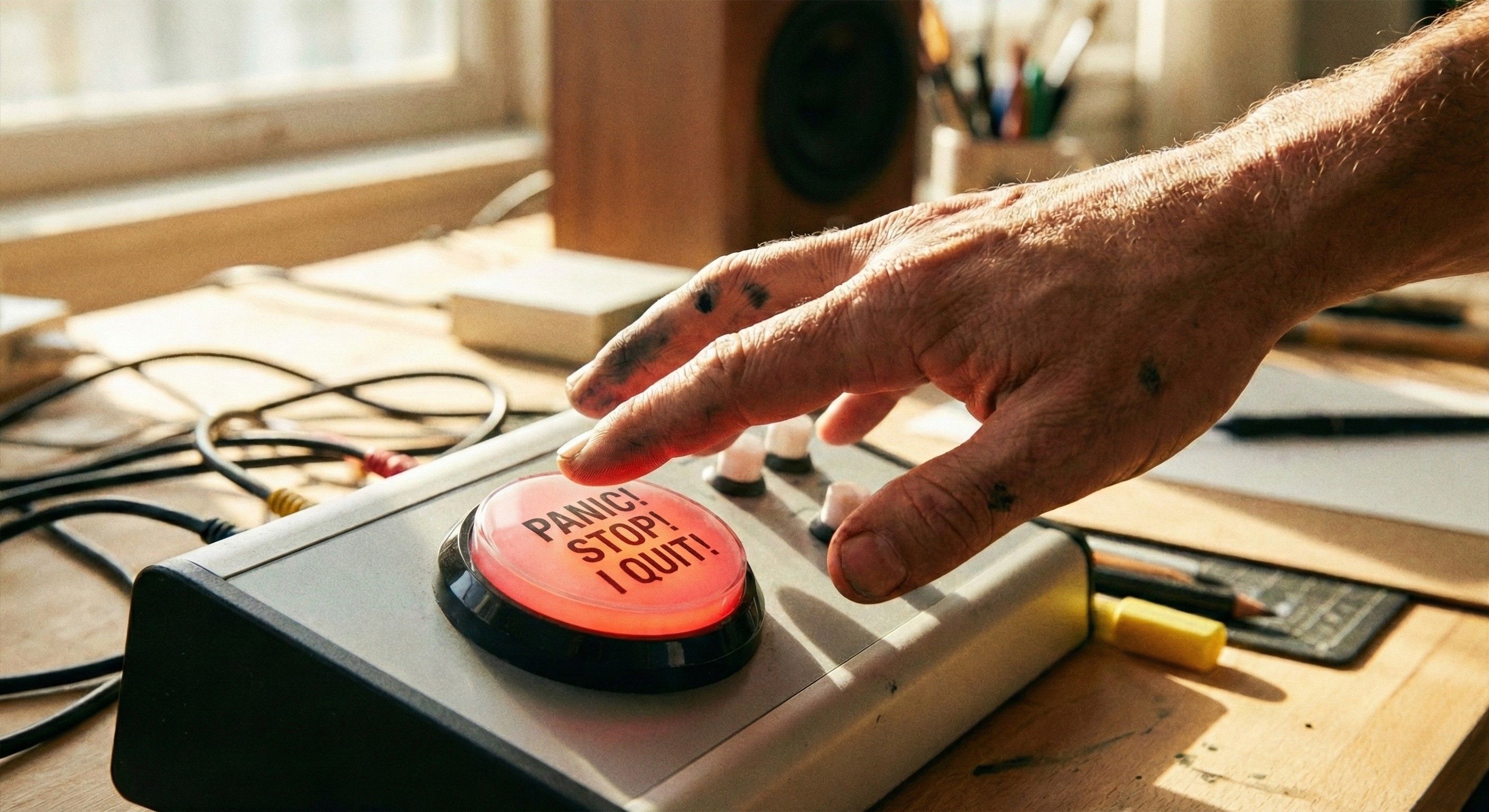
What if, in that critical moment, you had a button you could press?
Not a button that locks your phone. Not a button that shames you. But a button that gives you exactly what you need in that moment: grounding, perspective, and a tiny next step.
This is the idea behind the Panic Button approach. It's built on a simple insight: when you're about to slip, you don't need motivation. You don't need a lecture. You don't need to be reminded of your goals.
You need someone (or something) to meet you where you are. To acknowledge how hard this moment is. To help you breathe. To give you one small action that feels possible.
What Makes Crisis Support Different
It Doesn't Judge
The last thing you need in a vulnerable moment is judgment. "You shouldn't be feeling this way." "Just use willpower." "Think about your goals." These responses make you feel worse, not better.
Effective crisis support starts with validation. "This is hard. It makes sense that you want to give in. You're not broken for feeling this way."
It Grounds You
In a crisis moment, your nervous system is often in fight-or-flight. You're not thinking clearly. You're reacting, not responding.
Good support helps you regulate first. A breathing exercise. A grounding technique. Something that brings your nervous system back to baseline so you can think clearly again.
It Offers One Tiny Step
When you're overwhelmed, big actions feel impossible. "Just don't eat the cookie." "Just go to the gym." "Just put down your phone." These feel like climbing mountains.
Effective crisis support offers something tiny. "Can you take three deep breaths?" "Can you drink a glass of water first?" "Can you set a five-minute timer before you decide?" Small enough to feel doable. Big enough to interrupt the pattern.
It's Available 24/7
Crisis moments don't follow a schedule. They happen at 11 PM on a Tuesday. At 3 AM when you can't sleep. On a random Sunday afternoon when a trigger catches you off guard.
Human support — friends, therapists, coaches — can't always be available. But your phone can. And that means your support system can be too.
Support when you need it most
bcome's Panic Button gives you instant grounding and guidance in the moments you're about to slip.
Try freeReal Stories, Real Moments
Let me share what this looks like in practice:
Maria was trying to quit emotional eating. She'd done well for a week, but one night after a stressful work call, she found herself standing in front of the fridge, hand on the door. Instead of opening it, she pressed the Panic Button in bcome. The app walked her through a breathing exercise, helped her name what she was actually feeling (overwhelmed and unappreciated), and asked if she could drink a glass of water and wait five minutes. She did. The urge passed. That night didn't become another "starting over" moment.
James was trying to build a consistent sleep schedule. At midnight, still wide awake and scrolling, he felt the familiar pull to "just watch one more video." He hit the Panic Button. The app acknowledged how hard it is to put down the phone when you're already in the scroll, helped him do a quick body scan to notice his tiredness, and suggested he just put the phone face-down for one minute. That one minute turned into putting it on the charger across the room. He was asleep by 12:30.
These aren't dramatic transformations. They're small interventions at critical moments. And they add up.
Why This Approach Works
The Panic Button approach works because it recognizes a fundamental truth about behavior change: the moment of crisis is where the battle is won or lost.
You can have the best goals in the world. The most detailed plans. The strongest motivation. But if you have no support in the moment you're about to slip, all of that can collapse.
Conversely, if you have support in those moments — if you can interrupt the spiral before it starts — everything else becomes easier. The slips become shorter. The returns become faster. The habit becomes stronger.
Building Your Own Panic Button System
Even without an app, you can start applying this approach:
1. Identify Your Crisis Moments
When are you most likely to slip? What triggers you? What time of day? What emotional states? Know your patterns.
2. Prepare a Grounding Tool
Have something ready that helps you regulate in the moment. A breathing technique. A physical action (like splashing water on your face). A mantra. Something that takes less than a minute.
3. Define Your Tiny Step
Decide in advance what your "tiny step" will be when crisis hits. "I'll drink a glass of water first." "I'll take ten deep breaths." "I'll wait five minutes." Make it specific and easy.
4. Have It Accessible
Write these down somewhere you can access quickly in a crisis moment. A note on your phone. A card in your wallet. Something that doesn't require you to remember when your brain is foggy.
The Bottom Line
Most self-improvement focuses on the beginning — setting goals, making plans, finding motivation. Some focuses on the middle — tracking progress, building streaks, staying accountable.
Almost nothing focuses on the moment of crisis. The moment you're about to fall. The moment everything is on the line.
That's the gap the Panic Button approach fills. It's not about having a perfect plan. It's about having support when the plan falls apart.
Because that's when you need it most.
And that's when it matters most.